
The Challenge
Physical safety monitoring—such as fire and gas detection—is frequently left as an isolated hardware problem, disconnected from the broader operational systems required for immediate action. While scattered sensor nodes can detect danger, without a unifying integration layer, critical data lacks a reliable pathway to centralized dashboards, notification systems, or the platforms that property operations teams use to respond in real time.
The Solution
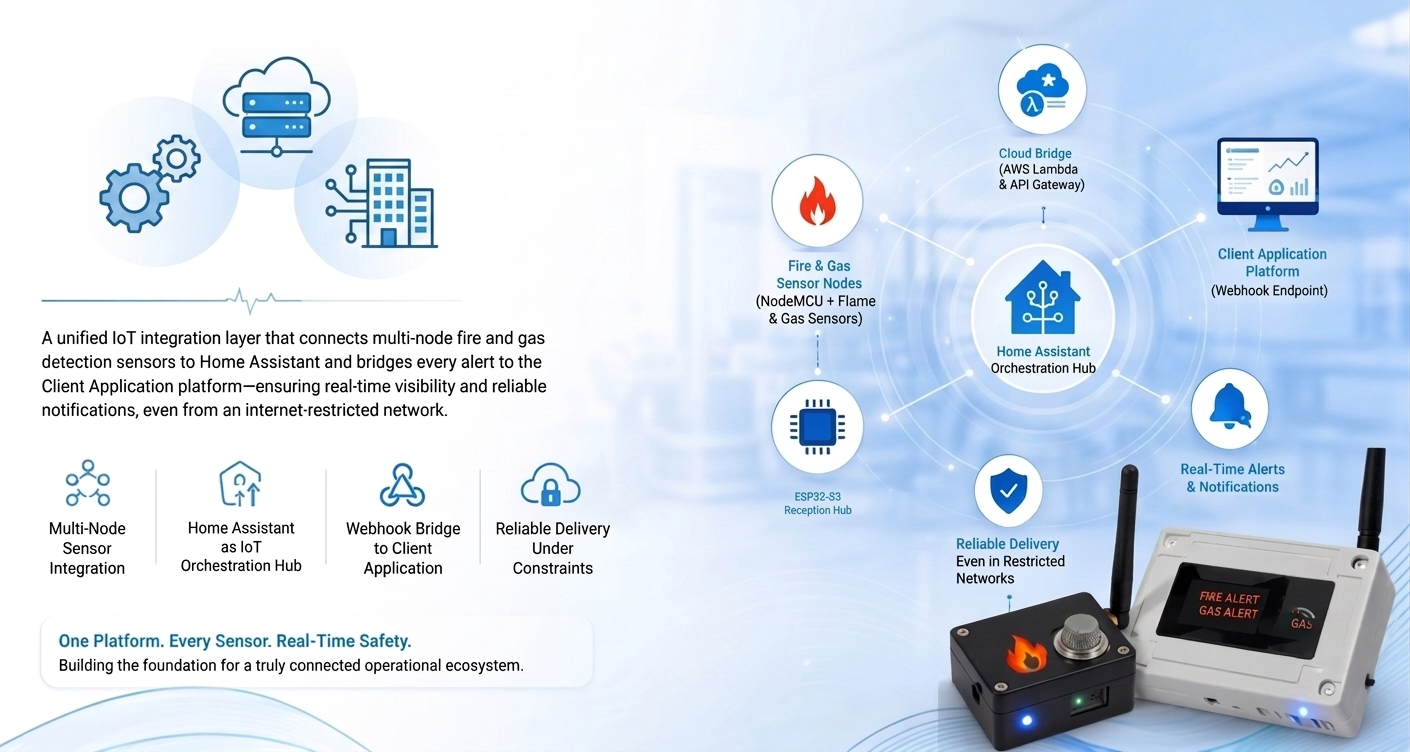
A multi-node fire and gas detection network was integrated into Home Assistant as a central IoT hub, with sensor readings and alarm events seamlessly published to the broader property management platform via automated webhooks. NodeMCU-based sensor nodes—each fitted with gas and flame sensors—report into an ESP32-S3 reception hub. The system efficiently handles device onboarding, automation logic, and the reliable delivery of every safety event to downstream systems, even from facility networks lacking direct internet access.
Key Platform Capabilities
- Multi-Node Sensor Integration: Onboards distributed NodeMCU sensor nodes—each combining gas and flame detection—into a centralized platform as first-class entities, providing operations teams with complete, real-time visibility into every safety signal across the facility.
- Intelligent IoT Orchestration: Utilizes automated logic to interpret raw sensor states, including location-aware alarm triggering, all-clear synchronization across multiple sensors, and manual silence handling, effectively translating noisy hardware signals into clean, actionable events.
- Webhook Bridge to Property Management: Every fire and gas event is packaged into a structured payload and pushed to the property management platform's webhook endpoint via a cloud API bridge, ensuring critical detection events immediately reach the central operational system.
- Reliable Delivery Under Constraints: An AWS Lambda-backed API Gateway bridges the air-gapped sensor network to external notification and webhook services, guaranteeing that critical safety alerts remain dependable even when the local network experiences restricted outbound internet access.
Executive Value & Future Vision
By unifying distributed fire and gas sensors into a centralized IoT architecture, property leaders can transform reactive safety measures into a proactive, intelligent alerting ecosystem. This connected foundation ensures immediate, location-aware emergency responses while establishing a scalable baseline for advanced life-safety automations. Future enhancements can leverage this robust architecture for predictive sensor maintenance, real-time spatial mapping of gas leaks or fire spread, and automated integrations with broader building management systems—such as triggering automated gas valve shut-offs or activating HVAC smoke extraction protocols.