
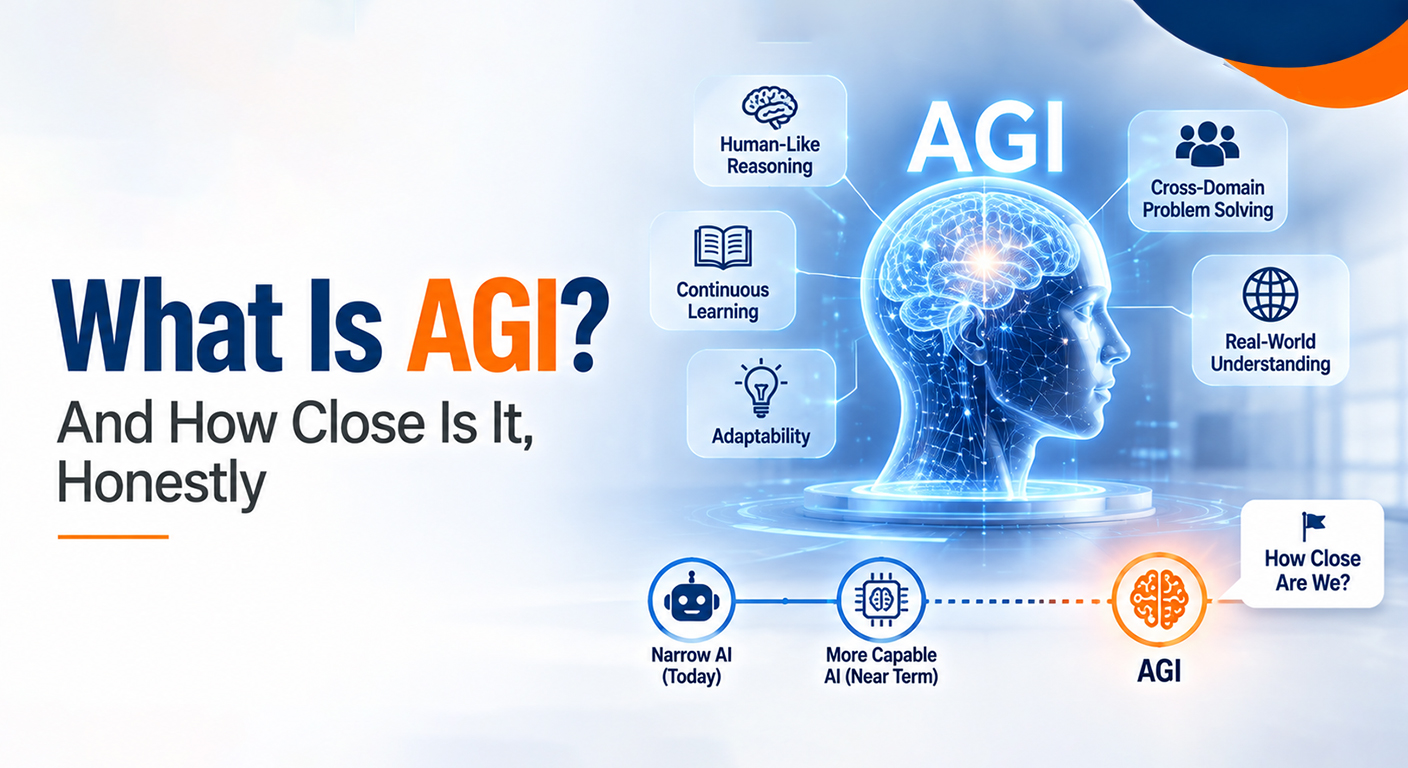
AGI in 2026: How Close Are We Really?
Somewhere right now, a founder is on stage telling investors AGI is eighteen months away. Somewhere else, a researcher is quietly rolling their eyes, because they spent last week watching a state of the art model fail at a word problem a ten year old would solve in seconds. Both of these people are looking at the same technology. That gap alone tells you everything about where we actually stand.
The trick everyone falls for
Here is the thing nobody tells you about AGI is near claims: they almost always come from someone with something to sell. A bigger round. A higher valuation. A headline. That does not make the underlying progress fake. The progress is real and it is fast. But the confidence in the timeline? That is marketing wearing a lab coat. Take Demis Hassabis, who runs Google DeepMind and knows this technology as well as anyone alive. Speaking in early 2026, he compared AGI’s potential impact to ten times the Industrial Revolution, unfolding over a decade instead of a century. A few months later he softened the framing slightly, saying humanity is standing in the foothills of the singularity with only a handful of years left to prepare. Even he keeps moving his own goalposts, sliding between 2029 and somewhere between one and five years depending on the interview. When the person building the technology cannot pin down a year, that should tell you something about how solid these timelines really are.
What actually changed
For a decade, AI progress meant one blunt strategy: bigger model, more data, repeat. That era is dying. What is replacing it is more interesting. Models now stop and think before answering. They check their own work. They call tools, run code, search the web, and correct themselves mid task instead of confidently barreling into nonsense. This is not theoretical. DeepMind is currently building an automated materials science lab in the UK where AI systems direct robots to synthesize and test hundreds of new materials a day, cutting years off traditional discovery timelines. Hassabis himself has called this soft self improvement, pointing out that coding agents are already making engineers dramatically more productive, even if the systems are not yet improving themselves in a runaway sense. That is a real shift, not a marketing one.
And then it faceplants
Give one of these systems a messy, ambiguous, real world problem, something that mixes two ideas it has never seen combined before, and watch it collapse with total confidence. No hedging, no I am not sure. Just a wrong answer delivered like gospel. Yann LeCun, the researcher who helped invent modern computer vision and spent over a decade as Meta’s chief AI scientist, has built an entire second act around this exact criticism. He argues that large language models achieve superhuman results in narrow domains but fundamentally lack any real understanding of how the physical world works. At a conference in Davos this January, he described sensory data as high dimensional, continuous, and noisy in ways that generative architectures simply are not built to handle. He left Meta at the end of 2025 to build what he calls world models instead, systems trained on video and physical interaction rather than text alone, because he believes chatbots dressed up as agents are, in his words, a disaster waiting to happen. That is not a rounding error. That is the entire ballgame. General intelligence is not about acing a test you have seen a thousand variations of. It is about handling the one you have never seen at all.
So why does this argument never die
Because nobody agrees on what AGI even means, and the people arguing loudest usually benefit from picking whichever definition makes their claim true. You can see this exact disagreement play out between two people who talk to each other regularly. Anthropic’s Dario Amodei has floated timelines as short as twelve to twenty four months for systems that match Nobel laureate level performance across many fields. Hassabis, sitting next to him at the same event, put his own odds at a fifty percent chance by the end of the decade. Two people with direct access to the most advanced systems on the planet, and their estimates differ by years.
Here is what nobody wants to say out loud
You do not need AGI. Your business does not need AGI. The companies pulling ahead right now are the ones using narrow, sharply built AI, tools that read contracts, watch video feeds, triage support tickets, or write half decent code, and doing it today, while everyone else argues about a finish line that keeps moving. Waiting for AGI before you build anything is like refusing to drive a car until someone invents teleportation.
The honest answer
We are watching something extraordinary happen in narrow, expanding pockets of intelligence, not a sudden arrival of a general mind. The gap that remains, judgment, common sense, knowing what you do not know, might be the hardest problem in the entire field. Anyone who gives you a confident year on when it closes is guessing, and probably hoping you will not ask them to bet on it.