The Challenge
The organization's enterprise chatbot was built to handle complex, data-driven user queries such as KPI reporting, but its original architecture relied on traditional API calls with limited agent capabilities. A single LLM handled all decision-making, functions like order lookup were wrapped in static, predefined schemas, and there was no dynamic filtering or robust security layer. This tightly coupled design struggled to scale to new functionalities, made multi-step tasks like generating KPI reports with complex filters cumbersome and error-prone, and left the system rigid and difficult to extend.
The Solution
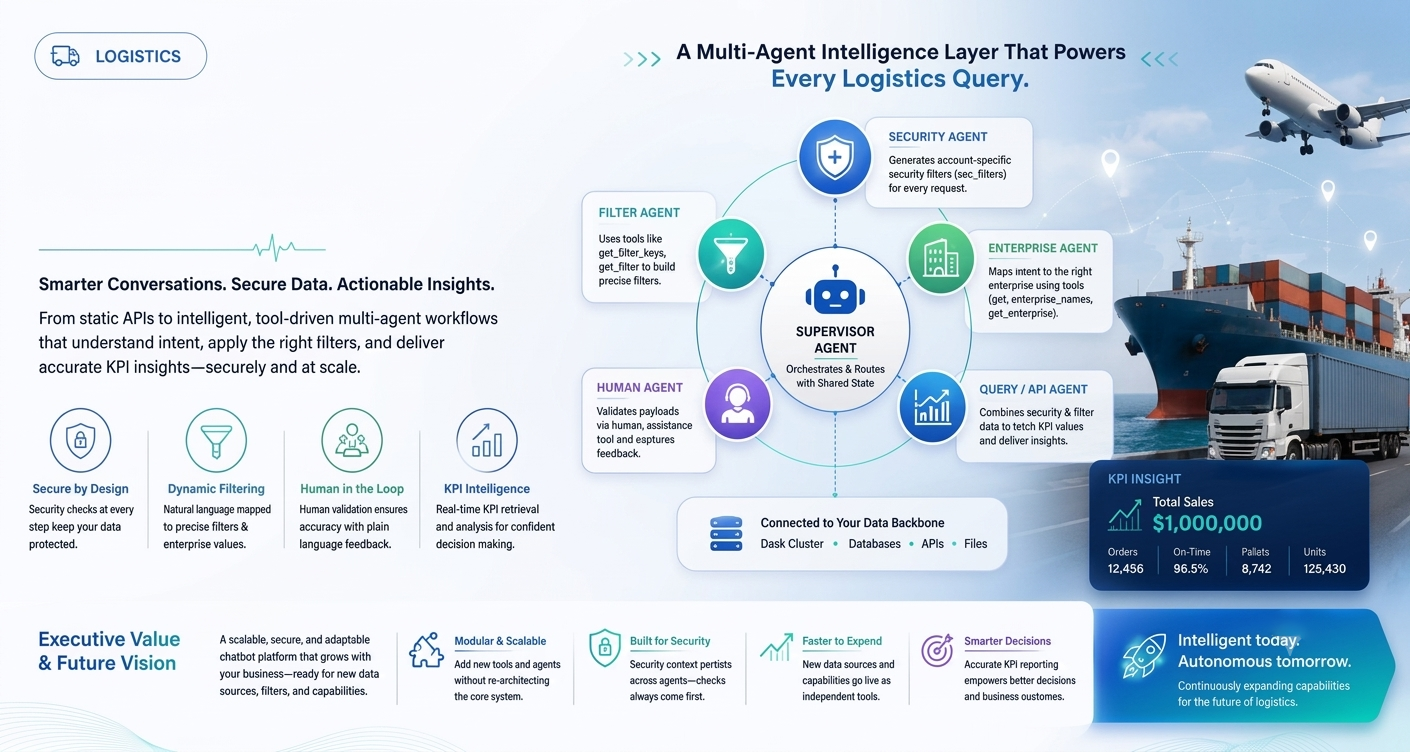
To resolve these bottlenecks, the chatbot was migrated to an MCP (Model Context Protocol) tools-based multi-agent workflow, powered by LangGraph and FastMCP. Instead of one LLM handling every decision, specialized agents—Supervisor, Security, Filter, Enterprise, Human, and Query/KPI—each own a distinct responsibility. These are orchestrated through a shared SupervisorState and connected to backend systems via a Dask Cluster, with an advanced LLM powering reasoning and tool selection.
Key Platform Capabilities
- Multi-Agent Orchestration: A Supervisor Agent routes tasks across Security, Filter, Enterprise, Human, and Query agents based on SupervisorState, replacing a single monolithic decision-maker with modular, purpose-built agents.
- Dynamic, Toolchain-Driven Filtering: The Filter and Enterprise agents use MCP tools via MultiServerMCPClient, with dedicated toolchains that let the LLM map natural-language intent to precise filter and enterprise values (e.g., "California" → "CA").
- Security Baked Into Every Step: A dedicated Security Agent generates account-specific security payloads that are merged into every Filter and Query request, with SupervisorState persisting security context across agents so checks always precede data access.
- Human-in-the-Loop Validation: The Human Agent validates filter and enterprise payloads through a human assistance tool, with the LLM interpreting feedback in plain language and updating state and routing accordingly—backed by robust error handling for malformed LLM outputs.
- KPI Retrieval and Analysis: The Query Agent combines security and filter data to fetch KPI keys and values, with the LLM analyzing results to produce clear, structured responses (e.g., "Total sales: $1,000,000").
Executive Value & Future Vision
By moving from static, tightly coupled API calls to a modular, tool-driven multi-agent architecture, logistics leaders gained a chatbot platform that is inherently scalable, secure, and adaptable to new query types and functionalities without re-architecting the core system. The MCP-based toolchain design means new data sources, filters, and capabilities can be added as independent tools and agents rather than hardcoded integrations. This connected, agent-based foundation positions the platform to continually expand its toolset and intelligence, paving the way for increasingly sophisticated, autonomous KPI reporting and decision support.