
The Challenge
Agricultural organizations frequently struggle with fragmented field management caused by disconnected environmental sensors and manual control systems. Lighting and physical monitoring often operate as standalone devices, resulting in limited operational visibility and administrative delays. When these essential processes rely on disjointed platforms and manual coordination, it becomes difficult to centrally monitor conditions, automate responses, and build a scalable foundation for connected agriculture.
The Solution
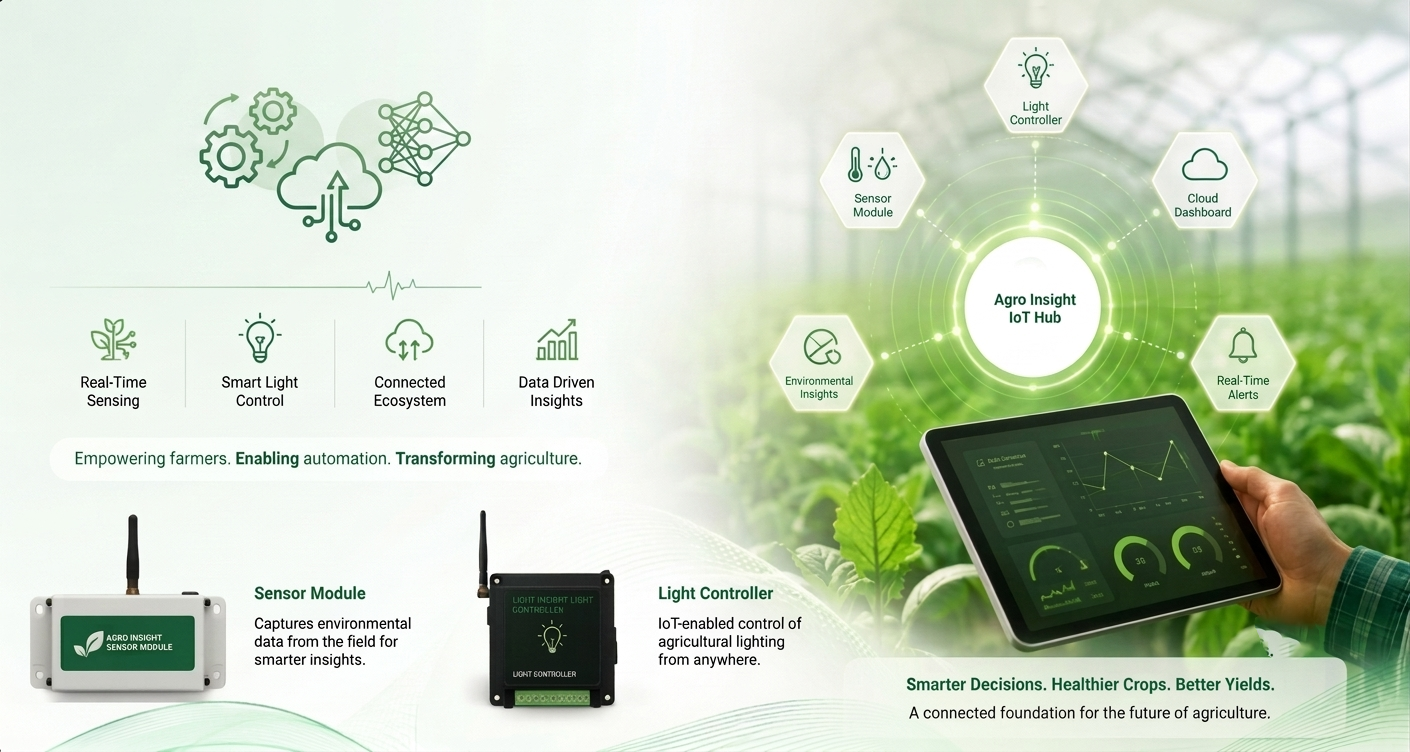
To resolve these bottlenecks, a comprehensive IoT-based control and sensing architecture was engineered to orchestrate the agricultural environment. By deploying a unified digital ecosystem that combines a dedicated light controller with an embedded sensor module, physical agricultural devices were seamlessly connected into a single monitoring and automation layer. This eliminates isolated manual controls and establishes centralized visibility and operation.
Key Platform Capabilities
- Continuous Sensor Telemetry: Utilizes a dedicated sensor module for capturing environmental conditions and seamlessly routing field-level data to the broader IoT ecosystem, creating a scalable foundation for adding future sensing capabilities.
- Centralized Operational Control: Implements a dedicated light-control module that enables agricultural lighting to be operated through an embedded IoT controller, replacing isolated manual workflows with a connected, remotely manageable approach.
- Embedded Hardware Orchestration: Combines microcontroller-based hardware, robust sensor interfaces, and control circuitry into purpose-built modules, providing a highly reliable interface between physical field equipment and the centralized digital monitoring layer.
- Event-Driven Automation: Establishes the hardware foundation required for automated operational workflows, allowing real-time sensor readings and environmental conditions to automatically trigger actions—such as lighting adjustments—without requiring manual intervention.
Executive Value & Future Vision
By unifying field telemetry and physical hardware controls into a single IoT ecosystem, agricultural leaders can deploy highly scalable and measurable farming operations. Crucially, this connected data architecture establishes a strong foundation for the next phase of digital transformation: moving beyond basic monitoring toward intelligent, condition-driven automation. This paves the way for expanding sensor coverage, integrating predictive analytics, and making field equipment autonomously responsive to real-time environmental shifts.