
The Challenge
Healthcare organizations frequently struggle with fragmented patient experiences caused by disconnected clinical, operational, financial, and logistical systems. Using Sleep Apnea care as a representative model, patients face a complex journey—from screening and insurance verification to equipment fulfillment and ongoing therapy. When these steps rely on manual coordination and disjointed platforms, it results in administrative delays, multiple handoffs, and limited operational visibility.
The Solution
To resolve these bottlenecks, a comprehensive digital workflow was engineered to orchestrate the complete healthcare journey. By deploying unified Patient and Admin UI platforms, the entire Sleep Apnea pathway was digitized—seamlessly connecting screening, telemedicine consultations, home sleep tests, electronic prescriptions, and post-care support.
Key Platform Capabilities
- End-to-End Clinical Orchestration: Guides patients through digital screening, online physician evaluations, at-home diagnostics, and specialized therapy coaching.
- Centralized Operational Control: The Admin UI provides role-based worklists, empowering teams to efficiently manage insurance eligibility, payments, device fulfillment, and clinical reviews without navigating multiple systems.
- Enterprise Integrations: Built on a robust, cloud-native tech stack (Angular, Node.js, PostgreSQL, AWS). The platform integrates seamlessly with industry-leading tools like VSee for telemedicine, DocuSign for digital prescriptions, Stripe/PayPal for payments, and EasyPost for shipment tracking.
- Event-Driven Automation: Leverages automated webhooks to process external events—such as shipment updates, payment transactions, and diagnostic results—instantly triggering the next required operational task or patient notification.
Executive Value & Future Vision
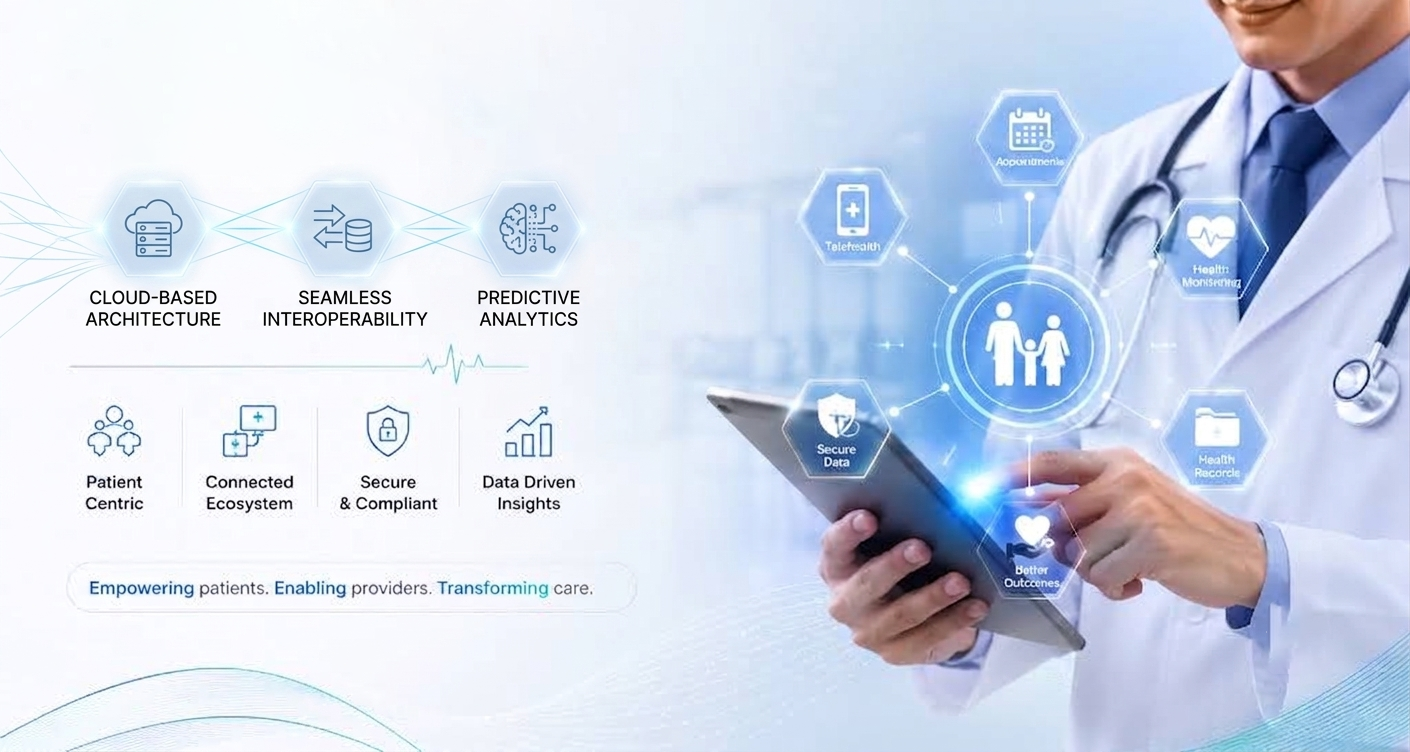
By unifying patient experience, clinical workflows, and backend logistics through API-led integration, healthcare leaders can deploy highly scalable and patient-centric platforms. Crucially, this connected data architecture establishes a strong foundation for the next phase of digital transformation: integrating Generative AI and Retrieval-Augmented Generation (RAG). This paves the way for intelligent operational assistants, automated bottleneck detection, and proactive workflow recommendations.